


 Nederlands
 Vlaams
 Deutsch

Throughout the last 35 years EMDR has become increasingly popular, which is due to its effectiveness in situations like managing trauma’s ranging from lighter experiences to severe traumas, and mental health diseases such as depression OCD, phobias, PTSD, bipolar disorder and even pain management. EMDR is short for Eye Movement Desensitization and Reprocessing which focuses on bilateral stimulation in order to desensitize a traumatic event. However, it being clinically approved doesn’t mean we know exactly what happens in the brain during this form of therapy. Neuroscience research around EMDR has been causing some discussions around which neural mechanism are activated. This article aims to explain what is known about EMDR so far, why it works from what we know, and the uncertainties we’re working out until this very day.
EMDR explained
Eye Movement Desensitisation Reprocessing (EMDR) is a form of therapy where bilateral stimulation is used to neutralise a traumatic memory. Bilateral stimulation uses rhythmic and alternating sensory input on various parts of the body. In the case of EMDR this is usually the visual field. By following an object from left to right with your eyes whilst thinking about the traumatic event, it reduces the emotional weight and vividness of the trauma, neutralising the memory.
Does EMDR truly work?
There have been many cases of different mental health diseases that showed effective changes in behaviour after having gone through EMDR therapy. Over 300 studies have examined EMDR’s clinical reach, and the results seem to all follow the same trend, showing that this form of therapy is equally or even more effective than medication and established psychological treatments for PTSD. This led to the World Health Organization formally recognising EMDR as a first-choice treatment.
Additionally, and perhaps even more striking, is how far beyond PTSD the evidence now reaches. Randomised controlled trials have shown meaningful improvements in people with bipolar disorder, psychosis, unipolar depression, panic disorder, OCD, dental phobia, alcohol dependency, and chronic pain.
These examples show that its effectiveness is almost unquestionable, but why does something as simple as bilateral stimulation work for desensitizing extremely traumatic events. To understand this, we first need to ask ourselves what happens unconsciously in the brain during EMDR which leads us to reduce the emotional weight of such events?
The AIP model
In order to understand EMDR in the brain it is important that we first understand how the brain processes information. Relevant for EMDR is the Adaptive Information Processing (AIP) model, which states that the brain has a natural way of processing experiences and files them into your memory through different sensible compartments. These compartments could be things such as emotion, knowledge, and context which eventually leads to the “digesting” them so they don’t stick around and intrude. This whole process happens naturally, at least most of the time.
What can happen during this process is that traumatic memories can get stuck, which means that the memory didn’t get integrated into this system. Instead of being stored as something that happened in the past, the memory gets frozen in its raw form: the images, the physical sensations, the emotions, all preserved exactly as they were in the moment of the trauma. The memory remains live which means anything that resembles the trauma can trigger the whole traumatic memory again. This is the core of PTSD.
During EMDR: the Baddeley & Hadley working memory hypothesis
During EMDR we’re actively stepping into our working memory, which is a short-term memory workspace for holding and manipulating information in the moment. In 1974 Baddeley & Hitch proposed a working memory hypothesis which explains that the workspace is controlled by the Central Executive, a brain’s control system which decides which storage system to use in the moment. There are two main storage areas – the verbal/auditory (phonological loop) and the visual/spatial area (visuospatial sketchpad).
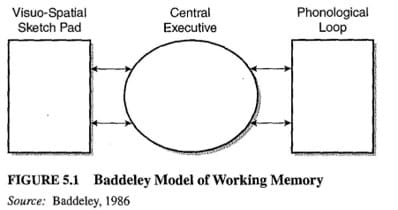
This model of working memory is one of the most well-known, but more importantly well-supported, explanations for why EMDR works. When you recall a traumatic memory, it lives in that visuospatial sketchpad. And when you simultaneously follow a moving target with your eyes, your brain is drawing on that exact same limited system to track the movement. The two tasks compete for the same resources, and your brain simply doesn’t have enough capacity to fully recall the traumatic memory while also doing something else demanding in that same space. This results in the memory becoming less vivid and less emotionally intense, making it neutralised and less intrusive over time. Your brain is essentially forced to hold the memory more loosely.
This has been supported by a large amount of experimental research, where studies consistently show that eye movements reduce the vividness and emotional weight of the recalled traumatic memories more than conditions where participants just recall the traumatic memories without any dual task. A 2013 meta-analysis of 26 randomized controlled trials confirmed that, in particular, eye movement used as a dual task for the bilateral stimulation contributes significantly to processing the traumatic memory, and therefore reducing the emotional load attached to it.
Neuroscience research in EMDR
Brain imaging studies show that during EMDR’s eye movement sets, the prefrontal cortex activity temporarily drops and then normalizes after successful treatment, with reduced limbic reactivity and a measurable shift of the memory toward integration areas of the brain. This means that during the EMDR treatment the effortful suppression that keeps traumatic memories frozen is relaxed.
EEG research shows the same trajectory: cortical activity moves from frontal to temporal regions over the course of treatment. This tracks the shift from raw emotional reactivity to cognitive processing, while physiological responses to novel stimuli broadly decrease which suggests that the nervous system has stepped down from chronic hyperarousal. The orienting response (the brain’s automatic survival “what is that?” reflex) also seems to play a role. The rhythmic bilateral stimulation seems to repeatedly trigger a state of calm which is paired with the traumatic memory over time. These mechanisms aren’t mutually exclusive, and newer hypotheses imply that the cerebellum and default mode network play an active role in this process as well, suggesting the full picture is still being assembled.
What we can say is that EMDR produces measurable changes, not just in reported symptoms, but also in the brain. And the closer neuroscience research gets to explaining the neural mechanisms behind EMDR, the more we understand how, and why, EMDR actually works.
Try EMDR for yourself
If you recognise something in what you’ve read, such as an experience that hasn’t quite been let go even though you want to, or a reaction that feels bigger than the situation actually is, then EMDR might be worth exploring for yourself. At GORTcoaching, EMDR is offered as part of a coaching trajectory, matched to professionals dealing with lighter traumatic experiences or stress that’s starting to get in the way. You choose your own psychologist or coach, and a free orientation conversation is the starting point. There’s no commitment, just a conversation. You can find more at https://gortcoaching.nl/emdr/.
SOURCES USED
- Baddeley, A. D., & Hitch, G. (1974). Working memory. In G. H. Bower (Ed.), The psychology of learning and motivation: Advances in research and theory (Vol. 8, pp. 47–89). Academic Press. https://doi.org/10.1016/S0079-7421(08)60452-1
- Calancie, O. G., Khalid-Khan, S., Booij, L., & Munoz, D. P. (2018). Eye movement desensitization and reprocessing as a treatment for PTSD: Current neurobiological theories and a new hypothesis. Annals of the New York Academy of Sciences, 1426(1), 127–145. https://doi.org/10.1111/nyas.13882
- Chen, Y. R., Hung, K. W., Tsai, J. C., Chu, H., Chung, M. H., Chen, S. R., Liao, Y. M., Ou, K. L., Chang, Y. C., & Chou, K. R. (2014). Efficacy of eye-movement desensitization and reprocessing for patients with posttraumatic-stress disorder: A meta-analysis of randomized controlled trials. PLOS ONE, 9(8), e103676. https://doi.org/10.1371/journal.pone.0103676
- Landin-Romero, R., Moreno-Alcázar, A., Pagani, M., & Amann, B. L. (2018). How does eye movement desensitization and reprocessing therapy work? A systematic review on suggested mechanisms of action. Frontiers in Psychology, 9, 1395. https://doi.org/10.3389/fpsyg.2018.01395
- Lee, C. W., & Cuijpers, P. (2013). A meta-analysis of the contribution of eye movements in processing emotional memories. Journal of Behavior Therapy and Experimental Psychiatry, 44(2), 231–239. https://doi.org/10.1016/j.jbtep.2012.08.001
- Shapiro, F. (2001). Eye movement desensitization and reprocessing: Basic principles, protocols, and procedures (2nd ed.). Guilford Press.
- World Health Organization. (2013). Guidelines for the management of conditions specifically related to stress. WHO Press. https://www.who.int/publications/i/item/9789241505406