

 Nederlands
 Deutsch

Written by Joyce Gerber
You always brush your teeth with the same hand, and you can take the same route to work every day without having to think about it, but how does this work in the brain?
We all have habits that we do unconsciously and that we repeat on a daily basis without any effort. Habits exist because we can do an action without having to use all the cognitive resources for it to happen, freeing up space for more important tasks. But what if the habits we’ve adapted aren’t actually helping us? And how do we work with our brain to change our patterns and, therefore, behaviours?
How Do Habits Form?
Your brain is constantly looking for ways to conserve energy and be efficient. One of the ways your brain does this is by turning repeated behaviours into automatic routines, so that no thought is needed for this behaviour, allowing you to think about more important matters.
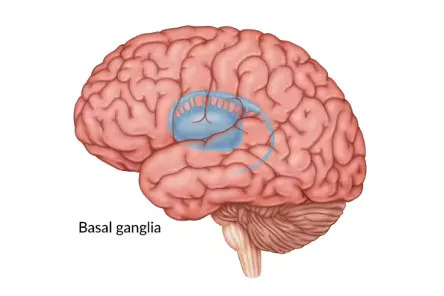
This automation happens in the basal ganglia (located in the centre of the brain), which you can view as your brain’s autopilot system.
Neuroplasticity
If you repeat a certain behaviour multiple times, your brain encodes it as an automatic routine. Neuroplasticity is the brain’s lifelong ability to adapt and form new neural connections leading to changes in behaviour.
Each time you execute a specific behaviour, you strengthen the neural network behind it and thus make such behaviour more automatic. The brain has evolved to automatise regularly repeated behaviours, to be able to free up resources for more important tasks.
Like in the case of driving a car or brushing your teeth, if you had to think of every step whilst doing that, you’d be mentally exhausted before even starting your day.
The Habit Loop
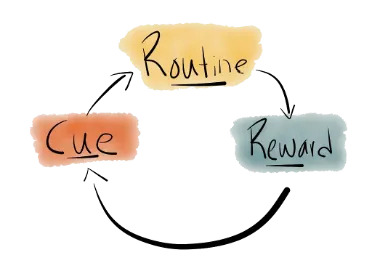
The Habit Loop, popularised by Charles Duhigg, consists of a cue, a routine, and a reward.
Cue
The trigger that initiates the habit, such as the time of day, location, or an emotional state.
Routine
The behaviour itself, such as scrolling, having a snack, or going for a run.
Reward
The payoff that tells your brain: “Remember this action because it’s worth doing again.”
Example:
- Cue: Feeling bored
- Routine: Picking up your phone after checking your messages
- Reward: The small dopamine hit you get from checking notifications and messages
With each repetition of this loop, the pattern in your brain becomes stronger, eventually making it automatic. After a while, you grab for your phone without making a conscious decision to do so.
Good and Bad Habits
Your brain doesn’t distinguish between good habits and bad habits. From a neurological perspective, the process is the same.
Whether you drink water or have a cigarette, your brain is simply trying to automate behaviours that it perceives as rewarding in some way.
This value-neutral aspect of habit formation explains why dopamine-rich rewards, such as sugar, substances, and social media, are hard to break.
Dopamine is often related to happiness, but it is more accurately described as a reinforcement chemical. It’s your brain’s way of saying:
Do that again.
Reward Prediction Error
What’s interesting is that dopamine doesn’t respond to the reward itself. It responds to the difference between what you expected to get and what you actually got. Neuroscientists call this the reward prediction error.
In the 1990s, Wolfram Schultz conducted a famous experiment where he gave monkeys a sip of juice after a light came on.
- Initially, dopamine spiked after the juice arrived.
- Once the monkeys learned that the light predicted the juice, the dopamine spike shifted to the light itself.
- When the juice was unexpectedly withheld, dopamine activity decreased.
This showed that the dopamine system acts more like a surprise detector than a reward detector.
How Does This Play Out for You?
This explains why simply seeing your phone or walking past a bakery can trigger cravings and urges.
It also explains why social media can be difficult to stop scrolling. You never know whether the next post or video will be better than expected, creating the possibility of another dopamine hit.
How to Change Your Habits
One insight from neuroscience research is that habits aren’t removed; they are replaced or overridden.
Your brain doesn’t erase old habit loops. Instead, it stores them in case they become useful again.
This is why someone who has stopped smoking for years can suddenly feel the urge again during a stressful situation.
Rather than simply quitting a habit, it’s often more effective to replace it with a healthier alternative that still provides a reward.
For example, if you reach for your phone when you’re bored, try reaching for a book instead. The key is to keep the cue and reward similar while changing the routine.
Step One: Build Awareness
Before making changes, you need to build awareness of your current habits.
Choose one habit you would like to change. Over the following days, whenever you engage in that behaviour, ask yourself:
- What happened right before I did this? (Cue)
- What exactly am I doing? (Routine)
- What reward do I seem to be getting from it?
Bringing a habit into conscious awareness weakens the automatic grip it has on you.
Working With Your Brain
Habit Stacking
Habit stacking means linking a new habit to one you already perform consistently.
For example, if you always brush your teeth in the morning, you can use that habit as a cue to perform some deep breathing exercises afterwards.
Design Your Environment
Your environment plays a powerful role in shaping your habits.
- Want to eat healthier? Keep healthy food visible and easy to grab.
- Want to reduce screen time? Put your phone in another room while working.
Increase friction for unwanted habits and decrease friction for the behaviours you want to encourage.
Use Dopamine Strategically
Because dopamine reinforces behaviour, you can make new habits more appealing by pairing them with something enjoyable.
- Listen to music while working out.
- Track progress using checklists.
- Set small, realistic goals that create quick wins.
This allows you to work with your brain instead of against it. You’re not forcing change; you’re rewiring patterns through repetition and rewards.
Small, consistent changes are usually more effective than trying to completely redesign your life overnight. Habits are built through repetition, not intensity.
You Don’t Have to Do It Alone
Understanding how habits work is one thing. Changing them and maintaining that change is another challenge entirely.
People are often blind to their own cues, and rewards can be more powerful than they initially realise. Even when you know what to do, underlying patterns may keep pulling you back into old routines.
Coaches can help uncover those patterns and support lasting behavioural change.
Are you ready to work with your brain instead of against it?
Sources
- https://neurosity.co/guides/reward-prediction-error-dopamine
- https://www.researchgate.net/publication/302578615_Dopamine_reward_prediction_error_coding
- https://www.health.harvard.edu/mind-and-mood/dopamine-the-pathway-to-pleasure
- https://www.sciencedirect.com/science/chapter/abs/pii/B9780443298677000438
- https://pmc.ncbi.nlm.nih.gov/articles/PMC6673057/
- https://pmc.ncbi.nlm.nih.gov/articles/PMC6701929/